
+9108334075584 / +919830654250
Experience innovative software solutions from ATM Softek Private Limited. Fill out the form below and our team will contact you soon.
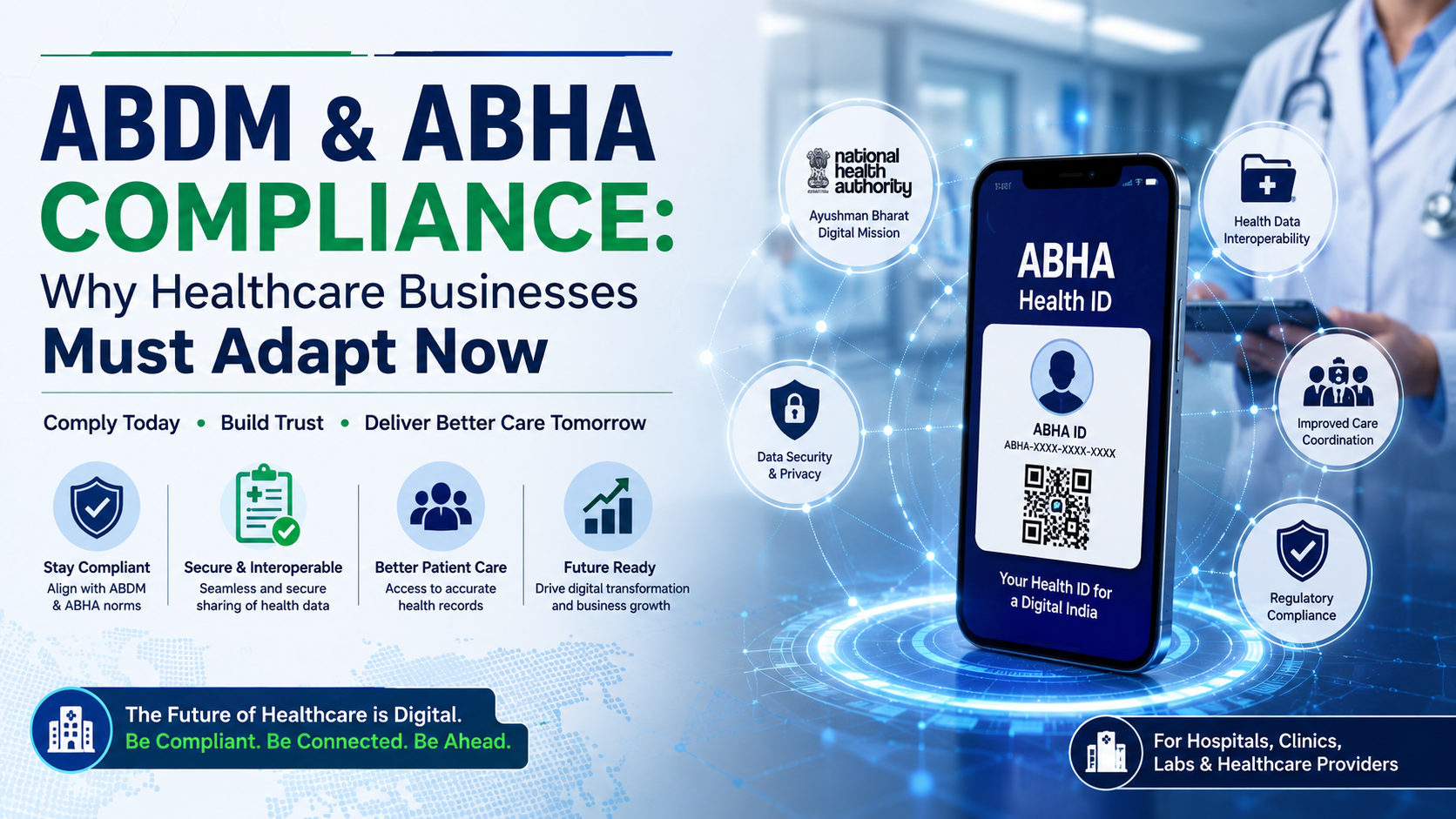
India’s healthcare sector is undergoing one of its most significant structural shifts in decades. At the centre of this transformation is the Ayushman Bharat Digital Mission (ABDM) a government-led initiative that aims to build a unified digital health infrastructure across the country. Alongside it, the ABHA health ID (Ayushman Bharat Health Account) is emerging as a foundational identity layer for every patient in the system. For hospitals, clinics, diagnostic labs, and health-tech companies, ABDM and ABHA compliance is no longer optional ; it is a strategic and operational imperative.
The Ayushman Bharat Digital Mission is a National Health Authority initiative which aims to create an interoperable digital health ecosystem in India. It establishes standards and frameworks for sharing electronic health records India-wide, linking patients, providers, and payers through a common digital infrastructure.
The ABHA health ID is a 14-digit unique identifier assigned to every citizen, enabling them to access and share their health records across ABDM-registered systems. ABDM compliance for hospitals and clinics means integrating their existing health information systems with ABDM, Health Information Exchange and Consent Manager (HIE-CM), so patient data can flow securely and with consent across the ecosystem.
The regulatory momentum behind ABDM is accelerating. Government hospitals and public health facilities have already begun mandatory onboarding. Private healthcare providers are next. Beyond regulatory pressure, three business realities make compliance essential:
Simply put, hospital digital transformation built on ABDM standards positions providers for long-term relevance in the Indian healthcare market.
Healthcare data interoperability is the most immediate and measurable benefit. When a patient moves from a primary care clinic to a specialist or diagnostic centre, their verified records travel with them ; no duplication, no gaps. Other concrete benefits include:
For pathology labs and diagnostic centres in particular, ABDM integration means lab reports can be linked directly to a patient’s ABHA profile — accessible to referring doctors instantly, securely, and without manual intervention.
The path to compliance is not without obstacles. Most healthcare providers encounter a combination of technical, organisational, and financial challenges:
These challenges are real but manageable — particularly when healthcare providers work with technology partners who have built ABDM compliance into their products from the ground up.
Healthcare compliance software built natively on ABDM standards removes the heaviest implementation burdens from providers. Purpose-built healthcare SaaS solutions handle ABDM integration at the platform level, meaning the clinic or hospital only needs to configure workflows rather than rebuild technology infrastructure.
ATM Softeks suite of healthcare software products & covering pathology lab management, hospital management, and eye care is designed with this transition in mind. ABHA ID verification, consent management, and ABDM-linked report delivery are integrated directly into the workflow, so providers achieve compliance without disrupting day-to-day operations.
When evaluating healthcare SaaS solutions for ABDM readiness, look for:
ABDM and ABHA compliance is not a future consideration it is a present-tense requirement. The National Health Authority is actively expanding the ABDM ecosystem, onboarding more facilities, and tightening integration mandates. Healthcare providers who begin compliance efforts now gain a competitive edge: faster empanelment, better patient retention, and operational systems that scale with the evolving landscape of digital healthcare India.
Waiting carries real cost & in missed patient registrations, regulatory friction, and the growing complexity of retrofitting compliance onto non-compliant systems. The question is not whether to comply, but how quickly you can get there.
ATM Softek works with pathology labs, hospitals, clinics, and eye care centres across 21 Indian states to make this transition practical and affordable. If your facility is evaluating ABDM integration for clinics or upgrading your HMS for ABDM readiness, our team is ready to guide the process.
Q1. Is ABDM compliance mandatory for private hospitals and clinics?
Currently, ABDM onboarding is mandatory for government and public health facilities. Private providers are strongly encouraged to comply, and regulatory mandates for private healthcare are expected to expand. Proactive compliance now avoids forced, rushed implementation later.
Q2. What is the ABHA health ID and how does it work?
ABHA (Ayushman Bharat Health Account) is a 14-digit unique health identifier for every Indian citizen. It enables patients to link their health records across ABDM-registered providers and share them with consent. Healthcare providers verify ABHA IDs at registration to access and contribute to the patient’s longitudinal health record.
Q3. How long does ABDM integration typically take?
With a purpose-built healthcare SaaS solution that already carries ABDM certification, integration for a mid-sized clinic or diagnostic lab takes a few weeks. Legacy system migrations or custom integrations may take longer depending on existing infrastructure.
Q4. Does ABDM compliance affect how patient data is stored and shared?
Yes. ABDM mandates a consent-based data sharing model. Patients control who accesses their health records. Healthcare providers must implement consent management workflows aligned with the HIE-CM framework. Compliant software handles this automatically.
Q5. How can ATM Softek help with ABDM and ABHA compliance?
ATM Softek’s healthcare software suite — which covers pathology labs, hospital management, and eye care — has ABDM integrated at its core. Our team provides onboarding support, training, and ongoing compliance updates. Contact us at info@atmsoftek.in to schedule a demo or consultation.

Our business solutions and services help accelerate innovation, increase productivity, reduce costs, and optimize asset utilization.
Copyright @. ATM Softek Private Limited. All Rights Reserved By ATM Softek Private Limited.