
+9108334075584 / +919830654250
Experience innovative software solutions from ATM Softek Private Limited. Fill out the form below and our team will contact you soon.
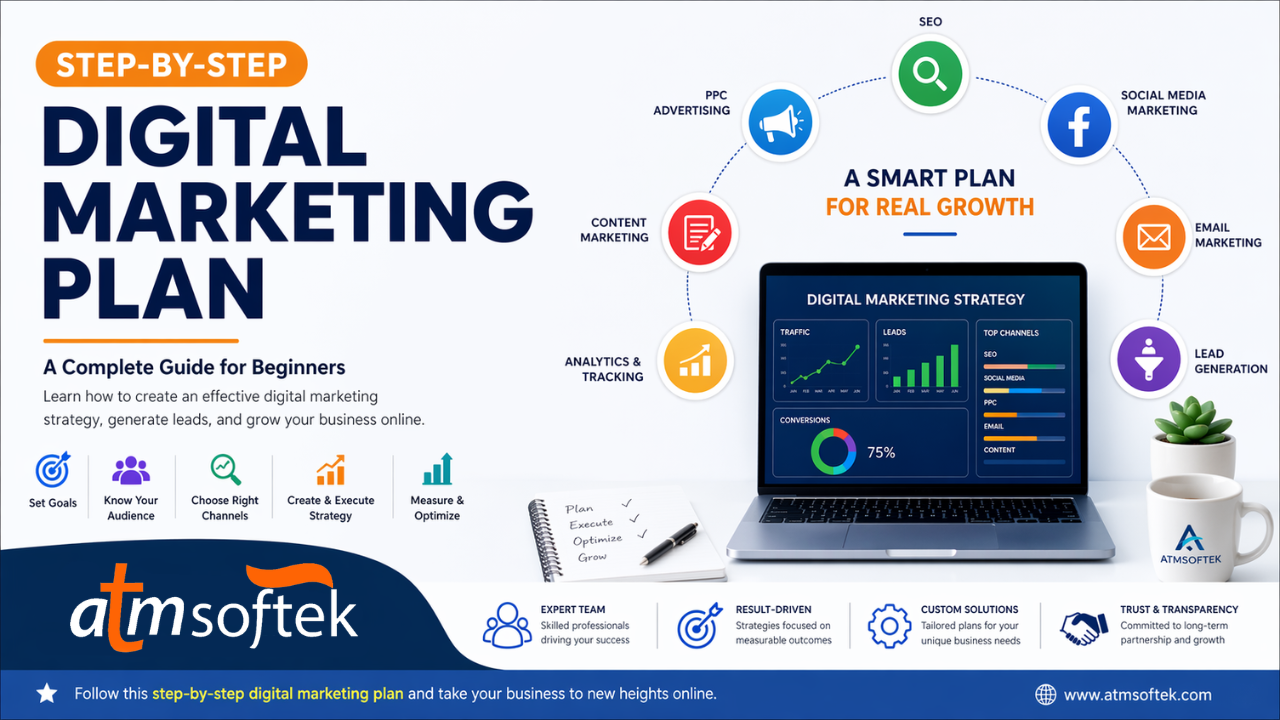
A step-by-step digital marketing plan is the foundation of any successful online business. Without a structured approach, businesses often waste time, budget, and effort on strategies that do not deliver results. Whether you are a startup, clinic, or software company, understanding how to create a digital marketing strategy allows you to reach the right audience, improve conversions, and scale efficiently.
This guide is designed as a digital marketing plan for beginners, breaking down complex concepts into actionable steps. It combines proven frameworks with practical insights so you can implement a strategy that works in real-world scenarios. By the end of this guide, you will understand digital marketing basics, key channels, and the exact online marketing strategy steps required to grow your business online.
Digital marketing refers to promoting products or services using digital channels such as search engines, social media, email, and paid advertising. The goal is to connect with your target audience where they spend most of their time—online.
The core elements include understanding your audience, selecting the right platforms, creating valuable content, and analyzing performance metrics. These fundamentals form the backbone of any successful step-by-step digital marketing plan.
Beginners should focus on clarity rather than complexity. Instead of trying every platform, start with one or two channels that align with your audience behavior. This ensures better resource allocation and measurable growth.
Every effective strategy starts with clear goals. Whether your objective is lead generation, brand awareness, or sales growth, defining measurable outcomes is crucial. Use SMART goals to ensure clarity and accountability.
For example, instead of saying “increase traffic,” set a goal like “increase website traffic by 30% in 3 months.” This approach makes your step-by-step digital marketing plan more focused and trackable.
Understanding your audience is critical. Define demographics such as age, location, and profession, along with behavioral traits like interests and online activity.
Knowing your audience helps in crafting personalized messaging and selecting the right digital marketing channels list. It also improves conversion rates by aligning your content with user intent.
Analyzing competitors provides insights into what works and what doesn’t. Study their content, ad strategies, SEO performance, and social media engagement.
This allows you to identify gaps and opportunities, making your digital marketing plan for beginners more strategic and less experimental.
Not all channels are suitable for every business. Selecting the right mix of SEO, social media, PPC, and content marketing is essential for building a balanced SEO social media and PPC strategy.
Focus on platforms where your audience is most active to maximize ROI and engagement.
A well-rounded step-by-step digital marketing plan includes multiple channels working together:
Search Engine Optimization (SEO): Improves organic visibility and long-term traffic.
Social Media Marketing: Builds brand awareness and engagement.
Pay-Per-Click Advertising (PPC): Drives instant traffic and leads.
Content Marketing: Educates and nurtures your audience.
Email Marketing: Maintains long-term relationships and repeat engagement.
Using a mix of these channels ensures both immediate and sustainable growth.
Content plays a central role in any digital strategy. A structured content marketing plan guide includes keyword research, blog creation, video content, and social media posts.
Focus on solving real problems rather than direct promotion. High-quality content builds trust, improves SEO rankings, and supports every stage of the marketing funnel. Consistency is key—publishing regularly ensures long-term visibility and engagement.
Understanding the marketing funnel helps in guiding users from awareness to conversion.
Top of Funnel: Attract users through blogs, ads, and social media.
Middle of Funnel: Engage users with informative content and comparisons.
Bottom of Funnel: Convert users through offers, demos, or consultations.
Each stage requires different messaging, making it an essential part of how to grow business online effectively.
Lead generation is a critical component of any step-by-step digital marketing plan. Effective techniques include creating optimized landing pages, offering lead magnets such as ebooks or free trials, and running targeted ad campaigns.
Retargeting plays a crucial role in converting interested users into customers. Additionally, integrating chat tools or WhatsApp automation can significantly improve response rates and conversions.
Growing a business online requires consistency, data-driven decisions, and continuous optimization. Track key performance indicators such as traffic, conversion rates, and return on investment.
Experiment with different strategies, analyze results, and refine your approach regularly. Businesses that adapt quickly to data insights achieve sustainable growth and competitive advantage.
Choosing the right partner can accelerate your success. ATMSoftek combines technical expertise with marketing strategy, especially in healthcare and software domains.
They provide customized solutions, focusing on lead generation and measurable growth rather than vanity metrics. Their integrated approach ensures that your step-by-step digital marketing plan is executed efficiently, making them a reliable choice for businesses looking to scale online.
Start with a clear strategy and avoid jumping between platforms. Focus on consistency in content creation and engagement. Always track your performance metrics and optimize campaigns based on data insights.
Invest in learning and stay updated with industry trends. Most importantly, prioritize user experience—businesses that provide value consistently outperform competitors in the long run.

Our business solutions and services help accelerate innovation, increase productivity, reduce costs, and optimize asset utilization.
Copyright @. ATM Softek Private Limited. All Rights Reserved By ATM Softek Private Limited.