
+9108334075584 / +919830654250
Experience innovative software solutions from ATM Softek Private Limited. Fill out the form below and our team will contact you soon.
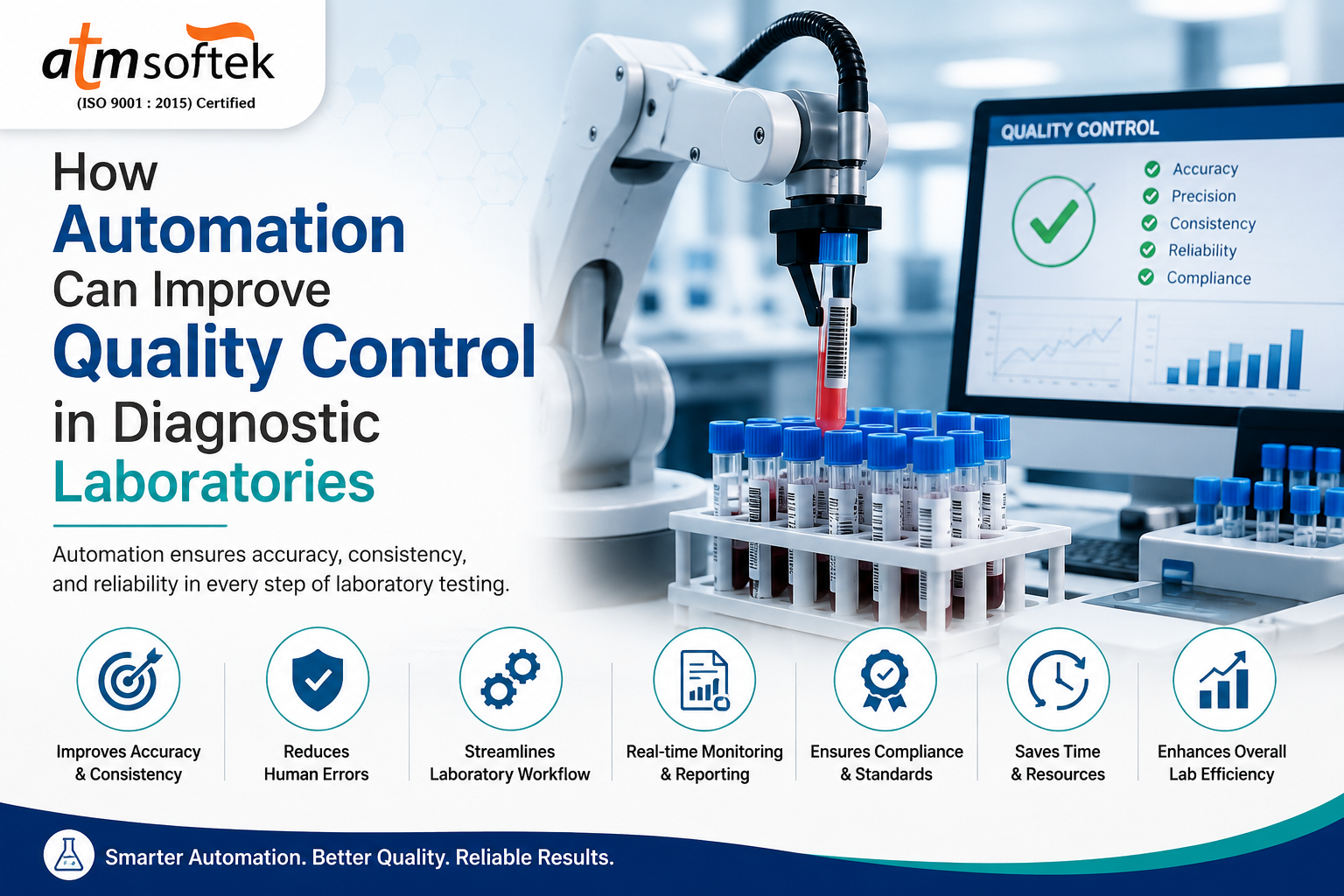
Learn how laboratory automation helps Quality Control in Diagnostic Laboratories through error reduction, enhanced test accuracy, efficiency, and consistency.
Quality control is the bedrock of all diagnostic laboratories. One mislabeled specimen, one skipped calibration step, and even a transcribed result could throw off a diagnosis and, in turn, patient confidence. As the number of specimens rises and the need for speed increases, more laboratories are adopting Laboratory Automation for Quality Control to maintain accuracy, consistency, and compliance with minimal strain on their employees.
Diagnostic Laboratory Automation is not only restricted to large reference laboratories anymore. Automated solutions now enable Quality Control in Diagnostic Laboratories of all sizes, from specimen accessioning to results validation.
Traditional methods of quality control depend a lot on human verification; for example, when it comes to verifying the labels of samples, keeping calibration logs manually and correlating the results prior to releasing them. Each of these steps is prone to errors and, as the number of tests increases, there is more risk of this happening. Automated Laboratory Quality Control minimizes the risks by integrating the verification process into the workflow itself.
The process of Automated Diagnostic Testing helps to standardise the procedures of testing, getting rid of all the variances that may come from manual processes. The analyzers use the same calibrated procedure for each sample, hence increasing Diagnostic Testing Accuracy.
Laboratory Error Reduction is one of the clearest gains from automation. Automated Sample Processing minimises manual pipetting, labelling, and data entry, the exact steps where transcription errors and sample mix-ups most often occur. When a system scans and verifies a sample automatically, the chance of it being matched to the wrong patient or test order drops considerably.
Automated Sample Processing also speeds up daily operations. Samples move through accessioning, testing, and result generation with minimal manual intervention, which shortens turnaround times and frees technicians to focus on exceptions, troubleshooting, and quality review rather than routine handling.
A Laboratory Information Management System (LIMS) sits at the centre of effective automation. It centralises Laboratory Data Management, tracking every sample, test result, and quality control check in one system. This gives lab managers real-time visibility into pending tests, calibration status, and result trends, making it far easier to spot anomalies before they affect patient reports.
Laboratory Workflow Automation connects these pieces into a single, coordinated process. A sample is logged and barcoded at collection, routed automatically to the correct analyser, and its results are captured directly into the LIMS without manual re-entry. Quality control checks, controls, calibration verification, and result-range validation, run alongside this workflow rather than as a separate, after-the-fact step.
Labs that follow a phased rollout, starting with the highest-risk steps before automating the full workflow, tend to see the smoothest transition and the clearest improvement in consistency.
Laboratory Automation for Quality Control is no longer optional for diagnostic labs aiming to keep pace with rising test volumes and stricter accreditation standards. By reducing manual handling, standardising testing, and centralising data through a LIMS, labs can achieve more consistent, accurate, and defensible results. ATM Softek Pvt Ltd, an ISO 9001:2015 certified company serving over 6,000 clients across 21 Indian states, builds automation and LIMS capabilities directly into its pathology laboratory management software, helping diagnostic labs strengthen quality control without disrupting daily operations.
It is the use of automated systems and software to manage sample processing, testing, and result verification, reducing reliance on manual checks and ensuring quality control steps are applied consistently across every test.
Automation minimises manual steps like labelling, data entry, and sample transfer, which are the most common sources of error. Automated Sample Processing and barcode verification catch mismatches before they affect a result.
A LIMS acts as the central hub for laboratory data, tracking samples, results, and quality control checks in real time. It connects instruments, staff, and reporting into one system, making automation coordinated rather than fragmented.
Yes. Automated systems apply the same calibrated process to every sample, removing the variability that comes with manual handling and helping labs deliver more consistent, accurate results across technicians and shifts.
It reduces repetitive manual work, freeing staff to focus on exceptions and quality review rather than routine data entry. Processes also move faster, with fewer bottlenecks and clearer visibility into where each sample stands.

Our business solutions and services help accelerate innovation, increase productivity, reduce costs, and optimize asset utilization.
Copyright @. ATM Softek Private Limited. All Rights Reserved By ATM Softek Private Limited.