
+9108334075584 / +919830654250
Experience innovative software solutions from ATM Softek Private Limited. Fill out the form below and our team will contact you soon.
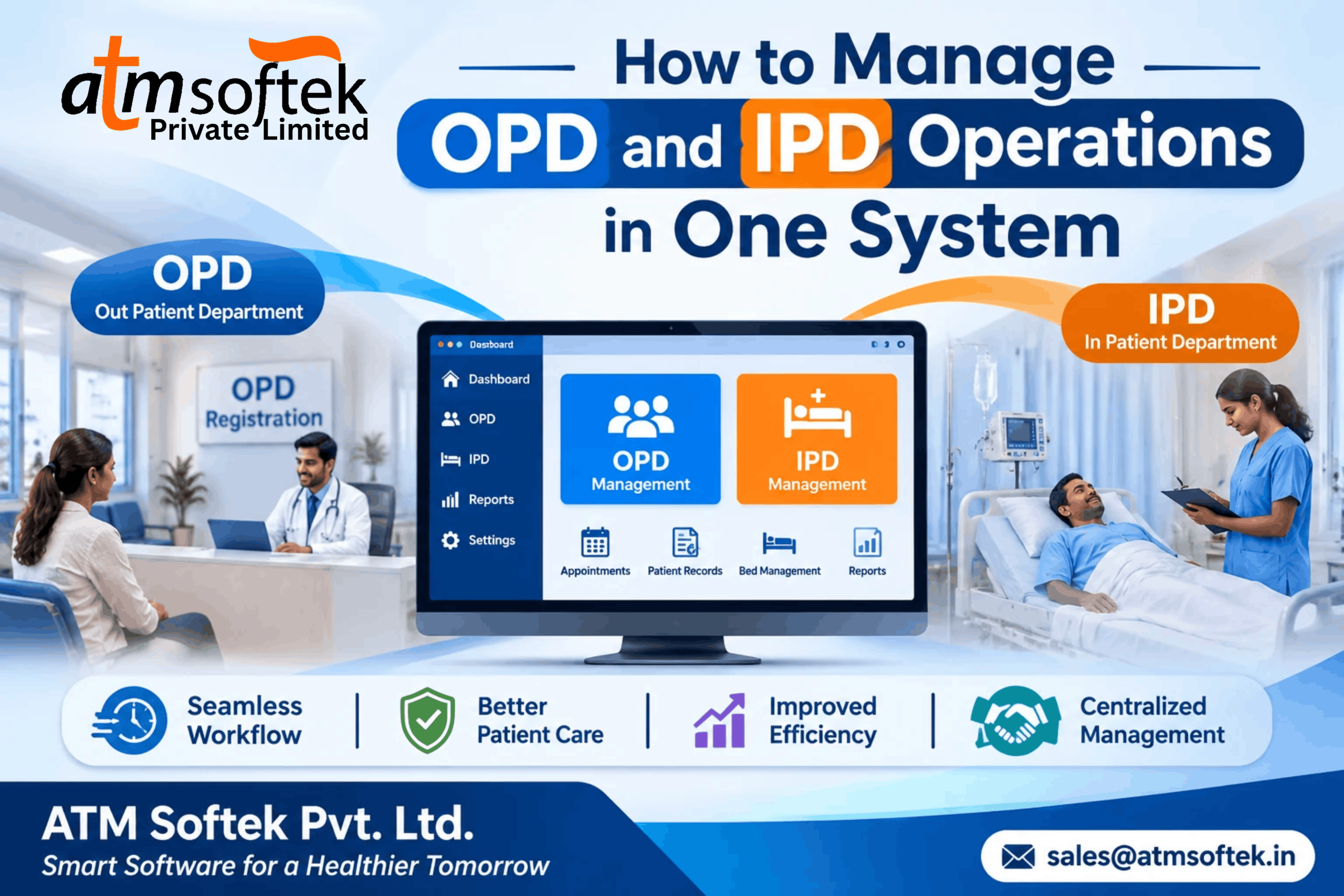
Picture a hospital at ten in the morning. The OPD counter has a queue snaking out the door, a nurse is flipping through files looking for one patient, and the billing desk is checking two different registers to work out what a family owes. Sound familiar? When OPD and IPD run on separate tools, patients lose time and staff lose patience. At ATM Softek Private Limited, we’ve worked with more than 6,000 healthcare clients across 21 Indian states, and the pattern is hard to miss. Hospitals that bring OPD and IPD into one connected system simply run smoother.
Here’s the problem with keeping them apart. A patient visits your OPD on Monday and gets admitted on Wednesday. If the two departments don’t share a record, someone has to register them again, ask about allergies again, and rebuild the history from scratch. Doctors don’t see the full picture. The accounts team spends evenings matching charges by hand. A single hospital management system (HMS) fixes this by keeping everything about a patient under one record, from the first consultation to the final discharge summary.
So what should good OPD and IPD management software do? In plain terms, it should follow the patient, not the department. Look for these basics:
• One patient ID, so you register someone once and every visit, admission and follow-up lands in the same file
• Appointments and tokens that thin out the crowd at the counter, with live queue tracking
• Bed, ward and admission management that shows what’s free right now, not what was free this morning
• One bill that combines consultation, room, procedure, pharmacy and lab charges
• Lab and pharmacy links, so orders and results reach the patient file without a phone call
• Simple dashboards for daily footfall, revenue and bed occupancy
1. Start by watching your own workflow. Spend a day at the registration desk and in the ward. Notice where patients wait, where staff retype the same details, and where bills go wrong. Those are your first fixes.
2. Build one patient record. Move OPD and IPD history into a single database. When a doctor opens a file, allergies, past diagnoses and prescriptions should already be there.
3. Make admission a one-click job. If a doctor advises admission, the OPD visit should turn into an IPD case without a fresh stack of forms.
4. Bring billing together. Charges from every department should flow into one running bill. Discharge gets quicker, and TPA and insurance claims stop bouncing back over mismatches.
5. Go live in phases and train your people. Start with registration and billing, then add wards, lab and pharmacy. Staff pick up new software faster when they see small wins early, so don’t rush it.
Hospitals that run OPD and IPD on one platform usually notice the same things first: shorter queues, faster discharges and fewer arguments over bills. Doctors spend less time hunting for files and more time with patients. Management finally gets reliable numbers without chasing every department. And patients feel it too. They feel known, because the hospital actually remembers them.
Not every HMS suits every hospital. A 20-bed nursing home needs something different from a multi-specialty centre, so pick software that can grow with you. Ask whether it fits your specialty, works on mobile, protects patient data and comes with support that actually picks up the phone. And always ask for a demo built around your own workflow, not a generic slideshow.
OPD (outpatient department) covers patients who visit for a consultation or tests and go home the same day. IPD (inpatient department) covers patients who are admitted and stay in a ward or room for treatment.
One system keeps a single patient record, so history, prescriptions and bills are never repeated or lost between departments. It also cuts duplicate data entry and billing mismatches.
Yes. A good HMS combines every charge into one bill, which makes insurance and TPA claims cleaner and faster to process.
Yes. Choose a system that scales, so a small nursing home can start with registration and billing and add wards, lab and pharmacy as it grows.
It depends on the size of your hospital and how much data you’re moving. A phased rollout works best: start with registration and billing, then add the other departments.
It can be, when the software uses role-based access, encrypted storage and regular automatic backups. Always ask your vendor how data is protected and who can see it.
Running OPD and IPD in one system isn’t a luxury anymore. It’s the base of a faster, safer and more profitable hospital. ATM Softek Private Limited, an ISO 9001:2015 certified healthcare software company in Kolkata, builds hospital and clinic management systems around real Indian hospital workflows. Want to see how it would work in yours? Get in touch with ATM Softek and book a free demo.

Our business solutions and services help accelerate innovation, increase productivity, reduce costs, and optimize asset utilization.
Copyright @. ATM Softek Private Limited. All Rights Reserved By ATM Softek Private Limited.